
The story of Dharmasthala began around 800 years ago in a sleepy hamlet called Kuduma, in the base of Karnataka’s Western Ghats. Here, the Jain chieftain Birmanna Pergade and his wife Ammu Ballalthi were renowned for their unwavering hospitality and charity. According to the legend, their lives changed the day four guardian angels (Dharma Daivas) visited, disguised as travelers. Delighted by the Pergades’ kindness, the Daivas revealed themselves in a dream and instructed Birmanna to dedicate his home to the worship of Dharma, thus planting the roots of a tradition centered on selflessness and harmony.
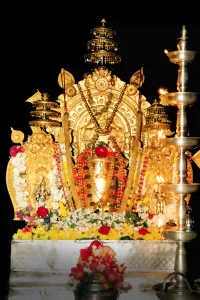
The Temple Through a 1950 Lens Obeying the divine directive, Birmanna Pergade vacated his house, established shrines for the four Dharma Daivas – Kalarahu, Kalarkayi, Kumaraswamy, and Kanyakumari, and was guided to devote his life to the propagation of Dharma. As the tradition of worship grew, Brahmin priests invited to perform rituals – advised the Pergade family to enshrine a Shivalinga alongside the native Daivas. At the behest of the Dharma Daivas, their vassal Annappa Swamy journeyed to Kadri (Mangalore) and brought back the idol of Lord Manjunatheshwara (a form of Shiva). This sacred lingam was installed at Dharmasthala, leading to the construction of the now-iconic Shree Manjunatha Swamy Temple. Dharmasthala thereafter became a remarkable confluence of faiths, a Shaiva Temple managed by a Jain Family, with Vaishnava Brahmins performing the rituals. Over twenty-one generations, the Heggade family transformed Dharmasthala into a unique Spiritual and Social Service Hub, upholding the four pillars of charity: Annadana (gift of food), Aushadhadana (gift of medicine), Abhayadana (protection and justice), and Vidyadana (gift of education).