"In the age of social distancing, screens became our windows to the world."
Authors –


When Covid-19 pandemic paused our everyday life, phones, laptops, TVs became more than mere gadgets, they became our windows to the world, our source of information, connection and sometimes our only source of comfort.
Whether we’re scrolling through instagram reels, watching news or following the latest trend on youtube, the media isn’t just updating us; it’s shaping how we think, feel and perceive the world around us. It shapes how we come together as a community.
Psychologically speaking, the media plays a crucial role in aiding us to build collective resilience – that is our ability to get through adversities and come out stronger, together (Bonanno et al.,2015). The reels we watch, the news we read and share aren’t just ways to kill time but a medium to shape how we handle stress, lift spirits and remind us that we’re all in this together. What really matters is how those stories are narrated. The tone, the content and the emotion that they leave behind.
Good News, Bad News and How it Shapes Us
Psychologists have long studied an interesting concept known as ‘emotional contagion’. It’s an idea that emotions spread from person to person, just like a virus (Hatfield et al., 1994). In today’s world, the media spreads emotions faster than ever. During COVID-19 pandemic, this became clear. Sometimes the content online lifted people and other times it added to their stress and fear.
For example, constantly reading or watching negative news or content (a habit popularly known as doomscrolling) was linked to higher levels of stress, anxiety and depression (Bendau et al., 2020).
On the other hand, viewing positive content actually helped people feel better. A study found that people who saw hopeful messages and content during the pandemic felt more confident and less helpless (Alpuim & Ehrenberg, 2023).
Finding Meaning Through Stories of Hope
When people experience a crisis, one of the most effective ways to cope is by finding meaning in what’s happening around. Psychologist Viktor Frankl (1959), in his book ‘Man’s Search for Meaning’ wrote that in the middle of deep suffering, if we can find a sense of purpose, we can endure almost anything.
During the COVID-19 pandemic, content that focused on kindness, strength and shared humanity helped people make sense of the chaos. Around the world, moments like Indians clapping for the doctors or Italians singing together from their balconies were powerful reminders that we were all in this together. These acts became emotional anchors, helping people feel connected despite being physically apart.
In India, one of the most powerful and widely shared stories was of the actor Sonu Sood. He went beyond his screen image and helped stranded migrant workers return home during the lockdown.
The media extensively covered his efforts not just because he was a celebrity but because his actions symbolized something deeper – kindness, hope and humanity in the time of crisis. People all over the country praised his effort and felt strong and hopeful. Psychologists call this vicarious resilience – when seeing someone else’s courage helps us feel stronger too (Hernandez-Wolfe, 2018). These stories were not just news – they were lifelines, helping people believe that even in darkest times, there is light.
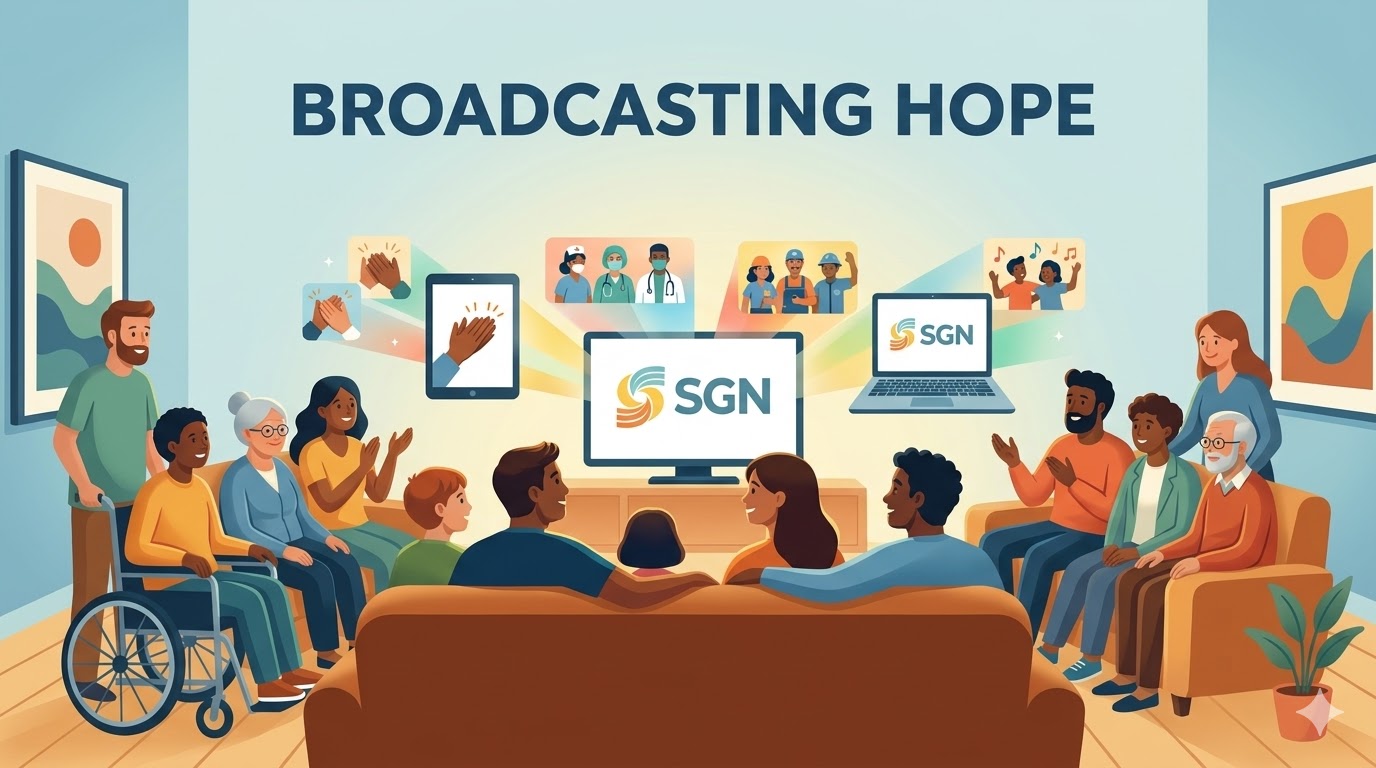
Broadcasting Hope: Media as Mental Health Support
During the pandemic, many people struggled with their mental health. Many reported feeling anxious, lonely and low as it became an experience for countless individuals (Xiong et al., 2020).
The media here played two significant roles. On some days, constant updates and negativity made things feel heavier. But when used with care, media also turned into a source of comfort. It became the only medium to feel connected, find support and even lift our spirits when we needed it the most.
For example, BBC’s ‘Headroom’ campaign was launched in 2021. It offered expert tips, calming exercises and real-life stories of people worldwide finding ways to cope. It was not just informative. But comforting on many levels when there was so much chaos around. This kind of content aligns with what psychologists say about the power of positive emotions. Barbara Frederickson’s Broaden-and-built Theory explains that when we feel good, we think more clearly, solve problems better, build inner strength and resilience over time.
Another beautiful example of media spreading hope and resilience was Some Good News, a YouTube series started by actor John Kransiki. While most channels covered news about fear and uncertainty, this show chose to highlight the good! The show streamed small acts of kindness, people supporting each other and moments that warmed hearts around the world. It was a reminder that even in hard times, there was still hope as so much good is happening around. It was not just feel good content – research by Eden et al. (2020) shows that hopeful content can actually boost our mood, lower stress and foster resilience making us feel stronger and hopeful. Simply put, these were not just stories that made us smile, they were little reminders of collective resilience helping us get through one tough day at a time.
From Spreading Fear to Sharing Solutions
News coverage often grabs our attention by focusing on fear of worst case scenarios. During the pandemic, there was widespread misinformation and negative information. Fear can push people to act quickly at first, but constantly seeing alarming headlines can wear us down. Over time, it can leave people fostering learned helplessness making people feel numb.
That’s the reason why psychologists and journalists are now focusing towards a better approach – constructive journalism. Instead of just showing what’s wrong, they highlight how people are responding, finding solutions and moving forward. In a world full of uncertainty, stories that show not just the problem but the path forward can make all the difference.
When Media Becomes a Tool for Healing
The media plays an essential role in shaping our perception especially during a crisis. In fact, the impact of media on our thoughts, feelings and behavior is so strong that some experts now believe that it should be used more intentionally as a part of public health efforts (Bavel et al., 2020).
The way a piece of information is narrated really matters. For example, during the pandemic, people were more likely to wear masks when the message focused on protecting themselves and the others – not only because it was a rule, but because it showed care and responsibility/ Similarly, stories that highlighted local food drivers, kind neighbours, medical workers or community vaccination events inspired people to step up and help. These kinds of stories did not just inform but encouraged kindness, self-control, hope and beyond all collective resilience which are key to getting through tough times as a society. When used with care and empathy, the media has the utmost power of doing more than just reporting. It can heal, uplift and guide people towards doing good.
Conclusion
As the world progresses and braces for future events such as wars, economic crisis, climate change – media must recognize its power. Beyond spilling facts, there is more need of feelings that unify, stories that inspire and narratives that heal. The media is not just a window to the world, it’s a mirror to our collective mindset. Let us ensure it reflects not just fear, but resilience and faith in humanity.
Reference List
-
Alpuim, M., & Ehrenberg, K. (2023, November 16). From helpless to hopeful: How journalists can inspire audiences to feel more empowered. Bonn Institute. Link
-
Bavel, J. J., Baicker, K., Boggio, P. S., et al. (2020). Using social and behavioural science to support COVID-19 pandemic response. Nature Human Behaviour, 4(5), 460–471. https://doi.org/10.1038/s41562-020-0884-z
-
Bendau, A., Petzold, M. B., Pyrkosch, L., et al. (2020). Associations between COVID-19 related media consumption and symptoms of anxiety, depression and covid-19 related fear in the general population in Germany. European Archives of Psychiatry and Clinical Neuroscience, 271(2), 283–291. https://doi.org/10.1007/s00406-020-01171-6
-
Bonanno, G. A., Romero, S. A., & Klein, S. I. (2015). The temporal elements of psychological resilience: An integrative framework for the study of individuals, families, and Communities. Psychological Inquiry, 26(2), 139–169. https://doi.org/10.1080/1047840x.2015.992677
-
Eden, A. L., Grady, S. M., Reinecke, L., & Johnson, B. K. (2020, December 18). Media for coping during COVID-19 social distancing: Stress, anxiety, and psychological well-being. UF College of Journalism and Communications. Link
-
Hatfield, E., Cacioppo, J. T., & Rapson, R. L. (1993). Emotional contagion. Current Directions in Psychological Science, 2(3), 96–100. https://doi.org/10.1111/1467-8721.ep10770953
-
Hernandez-Wolfe, P. (2018). Vicarious resilience: A comprehensive review. Revista de Estudios Sociales, (66), 9–17. https://doi.org/10.7440/res66.2018.02
-
Xiong, J., Lipsitz, O., Nasri, F., et al. (2020). Impact of covid-19 pandemic on Mental Health in the general population: A systematic review. Journal of Affective Disorders, 277, 55–64. https://doi.org/10.1016/j.jad.2020.08.001