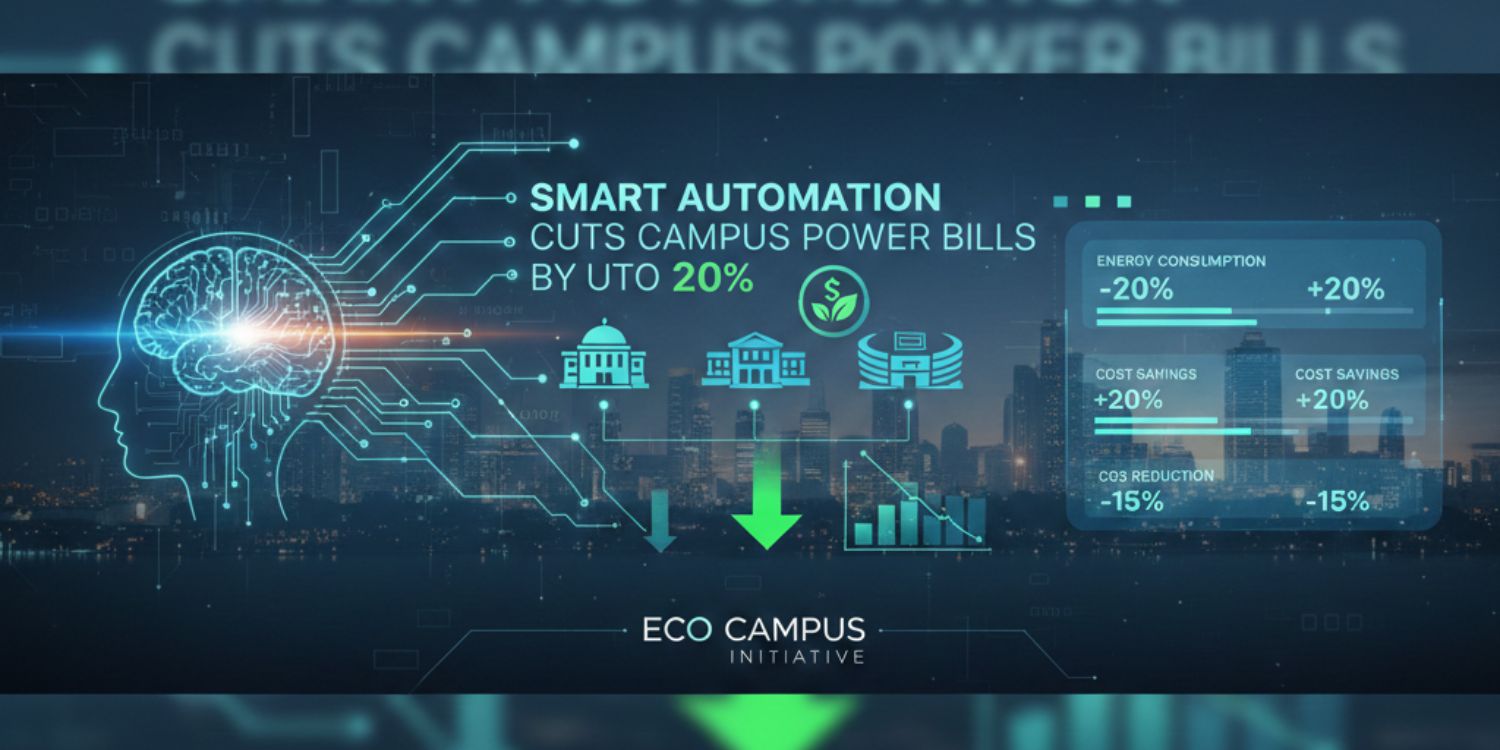
From Cambridge to Coimbatore, universities are proving that artificial intelligence can be both budget-friendly and climate-friendly. By implementing AI-driven smart automation, campuses are slashing electricity bills by up to 20%—freeing up funds for academics while making meaningful contributions to sustainability.
The AI Edge in Energy Management
Traditional campus energy management often means energy consuming assets are operating typically on fixed schedules operated via manual controls, and maintained reactively in response to problems or excessive energy consumption. AI has the potential to change that. By combining IoT controls and sensors, real-time occupancy data, and weather forecasting, AI systems can automatically adjust lighting, HVAC, and appliance usage based on actual demand.
Why Energy Savings Matter More Than Ever
The International Energy Agency (IEA) states that improved energy efficiency could deliver over 40% of the emissions reductions needed to meet climate goals. The United Nations Environment Programme (UNEP) emphasizes that reducing energy waste directly cuts fossil fuel demand, slowing global warming.
From India’s perspective, the Bureau of Energy Efficiency (BEE), under the Ministry of Power, highlights in its Annual Report 2023 that energy efficiency measures in educational and commercial buildings could save up to 20–30% of total electricity consumption. The Energy Efficiency Financing Platform (EEFP) also notes that optimized energy use extends equipment life—especially for HVAC units—reducing maintenance costs and material waste.
The Perform, Achieve, and Trade (PAT) scheme, although primarily for industries, underscores how targeted energy management can achieve measurable national savings—principles now being applied in the education sector as well.
Global Campuses Leading the Way
- University of Cambridge, UK – AI-enabled building management integrates weather, occupancy, and energy flow data, cutting electricity use by 27%.
- National University of Singapore (NUS) – Predictive cooling reduces AC energy consumption by 31% in the tropical climate.
- University of Melbourne, Australia – Combines AI with solar and battery storage to lower grid electricity purchases by 30%.
India’s AI Energy Success Stories
At IIT Bombay, the Smart Campus Energy Efficiency Initiative (2023) found that AI-driven lighting and HVAC controls in labs and hostels reduced annual electricity consumption by up to 20%, based on IoT meter data. At Amity University, Noida, a 2022 pilot in the Engineering and Management blocks cut monthly power bills by 18-20% through occupancy-based lighting and cooling automation, verified by its Energy Management Cell. At Vellore Institute of Technology, the Campus Energy Optimization Annual Review (2022) reported that AI-powered energy dashboards achieved a 25% cost reduction in selected buildings over 12 months. These results align with the International Energy Agency’s estimate that AI-enabled building management can reduce electricity use in large educational facilities by 20–40%, underscoring its transformative potential in higher education.
Companies Driving the Transformation
- BuildTrack Smart Automation – Indian pioneer that utilizes existing CCTV camera feeds from classrooms and public spaces for AI based Video Analytics to detect occupancy. This is used to automatically control energy consuming appliances like lighting and HVAC using IoT enabled controllers developed by BuildTrack. Savings potential ranges from these to be between 10-30%.
- Johnson Controls – Global leader in AI-driven building optimization.
- Siemens Smart Infrastructure – Provides energy analytics and automation for campuses worldwide.
Looking Ahead
As per India’s National Electricity Plan 2023, demand-side management—including AI-based automation—is expected to be a key lever for achieving national energy efficiency targets. With integration into renewable micro-grids, battery storage, and campus apps, savings could reach 40% in the coming decade.
Energy saved is climate saved—and across campuses, AI is proving to be one of the smartest teachers around.
About the Author
Dr. Rini, PhD (Marketing Management, IOT) | MBA (Gold Medallist), Panjab University
Dr. Rini is consultant, author, and faculty member at Panjab University, specializing in the fusion of technology and hospitality. She has led impactful IoT, AI, and cybersecurity initiatives for leading telecom brands including Vodafone, Reliance Communications, and TATA Teleservices. A sought-after speaker at forums such as PHDCCI, HRANI, and FHRAI, she champions sustainable, future-ready business models through the strategic adoption of emerging technologies. For any queries reach out at rini1045@gmail.com