
Tucked into the Miami Valley of southwestern Ohio, Wright State University has quietly built a reputation as one of the country’s most reliable public research institutions. Its engineering, computer science, and health science programs feed directly into the region’s dense cluster of aerospace, defense, and healthcare employers, giving technical majors a rare head start through internships, co-ops, and research partnerships that begin long before graduation. Wright State has also earned consistent recognition for helping lower-income students achieve strong post-graduation outcomes, a distinction that speaks less to prestige and more to purpose. Nowhere is that purpose clearer than at the Boonshoft School of Medicine, widely regarded as one of Ohio’s strongest producers of primary care physicians.
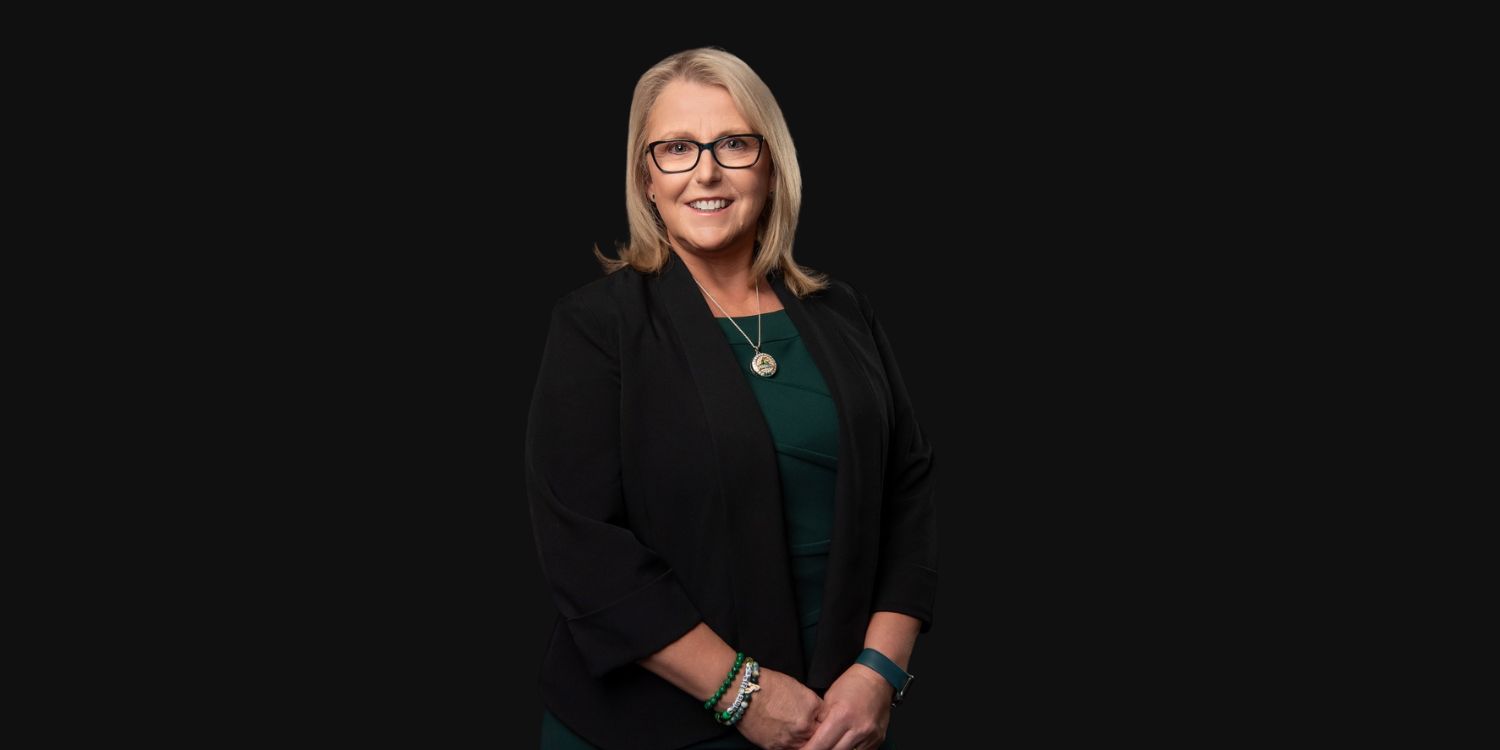
Sustaining that kind of impact across so many fronts doesn’t happen by accident. It demands leadership willing to go beyond institutional maintenance and directly into recruitment, retention, and relationships. That is precisely the mandate Susan Edwards took on when she stepped into the presidency. A physiologist by training and an educator by instinct, Edwards has made student success a personal cause, with particular focus on experiential learning, and classroom quality that actually prepares students for the world waiting outside it. She speaks about Wright State not as an employer but as a calling, and her visible pride in the university’s mission, serving its students and its region in equal measure, has become something of a signature. It’s this rare combination of qualities that places Susan Edwards firmly among the nation’s most influential education leaders in 2026.
The Mentors Who Shaped Her
Susan Edwards’ path into academia was shaped early by circumstance and mentorship in equal measure. Not long after finishing secondary school in her native Australia, she took on a role in the anatomical pathology laboratory at Geelong Hospital. That early exposure opened doors to further study and eventually pointed her toward a career in science.
Among the figures who left the deepest mark on her formative years was neuroscientist Dr. Colin Anderson, who guided her through her master’s degree. His encouragement and steady support gave her room to develop both academically and professionally, and when she shifted from medical sciences into biological sciences while still working full time, his flexibility and understanding made that transition possible.
Her doctoral advisor, Dr. Tes Toop, proved equally formative. Balancing a Ph.D. in Comparative Physiology while attending to the needs of early motherhood presented its own set of obstacles, and Toop’s empathy, drawn from having faced similar circumstances herself, offered reassurance that academic ambition and family life were not mutually exclusive. Beyond guidance, Dr. Toop opened up opportunities that helped her grow into not just a scientist but a scholar in the fuller sense.
Teaching Before Leading
Before her path led to a university presidency, Edwards spent years building a career across continents and classrooms. Across that stretch of her career, she taught within ten distinct degree programs spanning veterinary science, medicine, pharmacy, biomedical science, aquaculture, medical laboratory science, physiotherapy, exercise science, education, and nursing. Her instruction also reached indigenous communities across Victoria, Far North Queensland, and the Torres Strait Islands.
Asked how those years in the lab and lecture hall shaped her understanding of what students actually need to thrive, Edwards didn’t hesitate.
“You can only truly understand students by walking alongside them,” she said. Her own experience as a learner played into that conviction. “I was not a perfect student. I had to work hard, and eventually realized I am a kinesthetic learner. I learn best by reading, hearing, and doing.”
That self-awareness became the backbone of her teaching philosophy. She built classrooms designed around interaction and dialogue, wanting students to engage with material through more than one channel. But academics, she came to believe, were only part of the equation. “Student success is about far more than academics,” she explained. “It is about belonging, confidence, mentorship, and opportunity.”
Seeing Herself in Their Story
Wright State University, and Wright State’s students in particular, have always occupied a special place in the way Ms. Susan Edwards describes her career at the University. “The students drew me to Wright State,” she said. “When I visited campus during the interview process, I saw myself in the students I met.” Many were first-generation attendees, balancing coursework with jobs while trying to build something better for themselves and their families, circumstances that mirrored her own upbringing.
From that point on, she says, the role stopped feeling like a career move and started feeling like a calling. “I wanted to be part of an institution that was committed to serving students who might not otherwise have access to higher education,” she explained. “I have always believed that education changes lives because it changed mine.” That belief, she says, remains among her most enduring values and continues to shape her leadership daily.
Students Come First
Pressed on what principle sits at the center of her presidency, her response was unadorned. “Students come first,” she said simply. Once that priority anchors everything else, she added, the rest of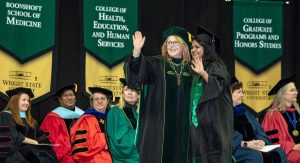 the job tends to fall into place around it, whether she’s sitting across from industry leaders to build internship pipelines, lobbying legislators on behalf of higher education, or courting donors to fund scholarships.
In her role as President, the real change, she believes, has happened not in messaging but in execution. “The most important shift has been moving beyond talking about student support to actively delivering it,” she said. “We have to walk the walk.” To her, that means students should feel those commitments in tangible ways – tutoring available when they need it, career advising that actually opens doors, internships, active student organizations, secure housing, and mental health resources woven into everyday campus life.
She’s quick to clarify that no single program can carry that weight alone. The goal, she says, is a campus-wide environment where support is simply assumed, resources are visible and easy to reach, and students never feel embarrassed to ask for help.
What worries her most, she admits, is the possibility that a student might feel abandoned by the institution meant to lift them up. “Our responsibility is to provide a strong network of support and ensure students have every opportunity to achieve their goals,” Ms. Susan Edwards reflected.
Life Beyond the Office
Beyond the demands of campus leadership, Ms. Susan Edwards maintains a life rich with its own rhythms. She’s an avid reader, typically juggling four or five books at once, ranging from light fiction to material tied more closely to her professional interests. Time outdoors matters just as much to her, particularly on the water, where kayaking offers one of her favorite forms of release. Gardening rounds out her list of pastimes, giving her another reason to spend unhurried hours outside.
Yet nothing recharges her quite like family. She describes them as a constant source of energy and grounding perspective, a feeling she finds echoed, somewhat unexpectedly, in her interactions with students. Hearing their stories, their ambitions, their lived experiences leaves her genuinely revitalized. Put simply, a room full of students is where she comes alive.
In the end, she reminds us, no one remembers who claimed the credit. What lingers are the outcomes. Do the work, invest fully in the people around you, and let the results carry their own weight, that, in her view, is what leadership actually looks like.
