
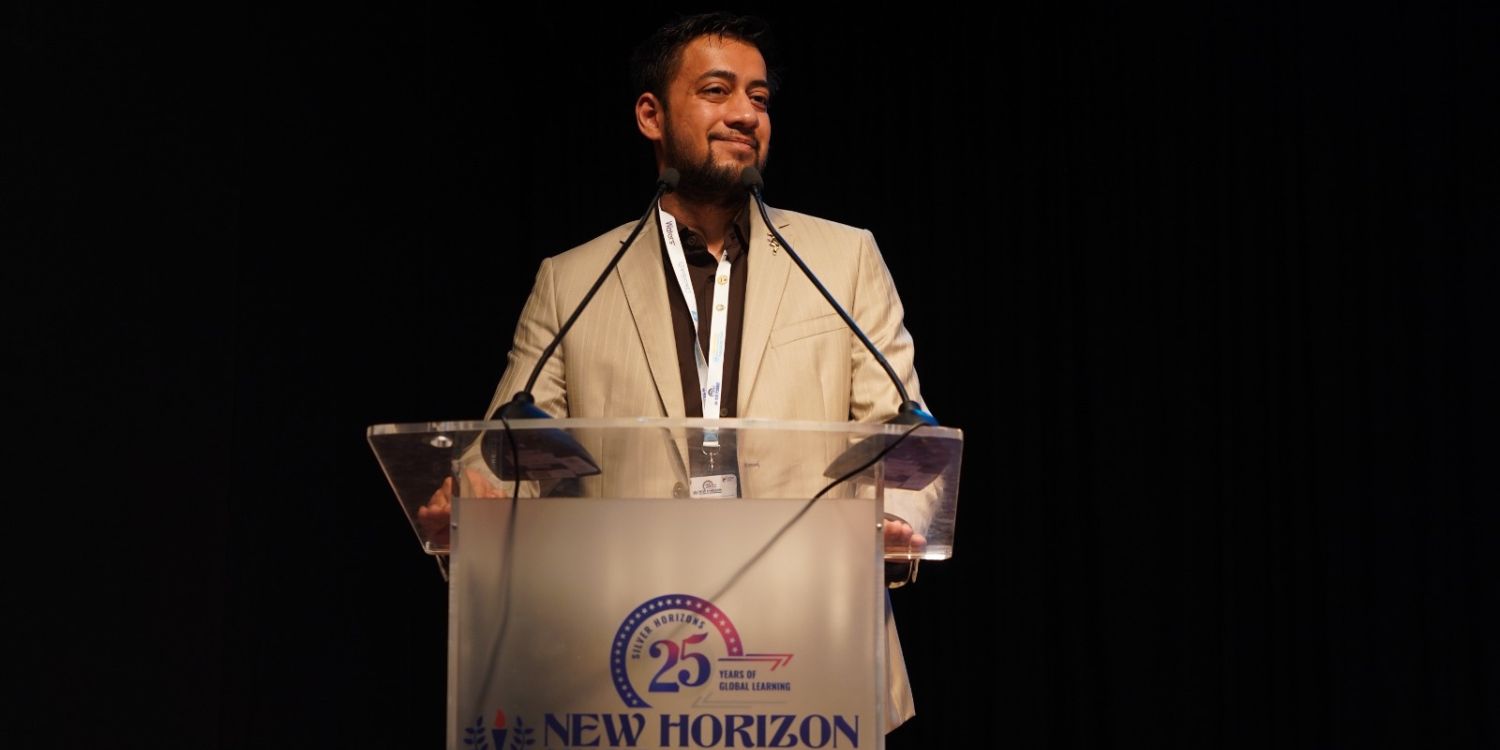
A student walks in with a start-up idea. Mr. Dhermesh Manghnani listens, questions the assumptions and pushes back on the weak spots. Once in a while, the pitch survives, and he gets to say the words he enjoys most. “This is actually a very good product. You should take this to market.”
Those conversations sit at the heart of how he leads New Horizon College of Engineering (NHCE) in Bengaluru. Founded in 2001, the college is marking its Silver Jubilee this year, with close to 5,000 engineering students and a top place across private engineering rankings.
As the college completes 25 years, he is shaping what the next 25 will look like, bringing AI-driven, personalised learning into its classrooms and planning a new university campus designed from the ground up.
Raised Around Institutions
Education has been part of his family’s life for many years. As a boy, he watched his father return home late at night still thinking about what the institution could do better.
That early exposure shaped a particular interest. “I became interested not simply in education, but in the art of building an institution,” he explains, from how curricula are designed to how a child grows into a confident, contributing adult.
Sport shaped him too. Mr. Dhermesh played basketball and badminton at the state level and later took up tennis, and he sees sport, infrastructure and academics as equal parts of a student’s growth.
Learning on the Job
To widen his view of the field, he pursued a diploma in International Perspectives in Education in the UK. The experience was valuable, and it also taught him that studying education and running an institution are two very different things. “A textbook can give you a framework, but experience teaches you how an institution actually functions,” he says.
He went on to take on a growing share of responsibility at New Horizon. Today his remit spans academics, student experience, technology, infrastructure, industry engagement, branding and long-term growth. Beyond education, he is also involved in real estate and other entrepreneurial and investment ventures, which often bring fresh ideas back to the campus.
A College at Twenty-Five
NHCE is an autonomous college affiliated to Visvesvaraya Technological University, accredited with an ‘A’ grade by NAAC and with NBA-accredited programmes. It offers engineering degrees in fields including AI and machine learning, data science and computer science, alongside MBA, MCA, M.Tech. and doctoral programmes. Two in five of its undergraduates come from outside Karnataka.
Its outcomes are steady. Of the 1,082 students who graduated in 2023–24, 748 were placed and 118 went on to higher studies, according to the college’s NIRF submission. More than 110 scholars are pursuing doctoral research, and the college handled 72 consultancy projects in the same year.
Mr. Dhermesh is also credited with growing Quantum X, the college’s technology festival, whose 2026 robo soccer contest drew 93 teams from cities including Pune, Mumbai, Chennai and Bhubaneswar.
Backing Student Founders
The initiative closest to his heart is New Horizon FUSE, the Foundation of Universal Startup and Entrepreneurship, the college’s entrepreneurship and incubation platform. He meets student founders, critiques their ideas and offers candid feedback. “Some of the ideas are unconventional, some need considerable work, and some are genuinely outstanding,” he says. Entrepreneurship has always interested him personally, and these sessions are among the most rewarding parts of his work.
A Small Moment, a Big Measure
One recent moment stays with him. While New Horizon was speaking to an international architecture firm about master planning a new project, the firm shared that two members of its team had reacted at once. “That was our school. We studied at New Horizon.”
“It was such a small moment, but it genuinely filled me with joy,” Mr. Dhermesh Manghnani says. For him, it showed how far an institution’s influence travels, and what success should look like. He wants every graduate to leave capable, successful on their own terms, and happy in what they do.
Smarter Tools, Deeper Thinking
He is optimistic about AI and believes institutions can no longer treat it as optional. Classrooms have long taught students of very different strengths and speeds in the same way. “For the first time, highly personalised education at scale is becoming genuinely possible,” he says.
He sees AI making good teachers more effective, freeing them from repetitive work to spend more time mentoring. At New Horizon, every new tool must pass the same test of whether it improves the student’s education. As information becomes easier to generate, he wants teaching to focus on critical thinking, judgement and creativity.
The pandemic, he notes, showed that students still value the campus, and that technology will change education without replacing its human element. That thinking now guides the next phase of growth, including a new university campus that he sees as a chance to reimagine the university of the future, academically, technologically and culturally.
Beyond the Campus
He does not believe in switching off at the end of the day, but he makes sure work is never the only thing in his life. Family matters deeply, and in a large, close family where many are educators, dinner-table conversation often returns to education. Sport remains his biggest passion, from tennis to hiking and trekking.
His advice to young educators is to experiment, question established systems and use technology boldly where it adds value. “But never innovate simply for the sake of appearing innovative,” he says. “Keep the student at the centre of the decision, and the rest tends to follow.”
