Healthcare stands at the core of society, yet recent global events have underscored the vital need for a workforce that’s not just skilled, but agile and equipped to tackle emerging challenges. As populations age, technology surges forward, and the quest for superior care intensifies, the call for top-tier healthcare professionals only grows louder, while shortages persist in critical areas. Compounding this is curricula often out of step with modern demands, falling short of industry benchmarks. In this arena, where many nursing institutes pledge elite education, clinical prowess, and the confidence to navigate varied healthcare settings, Poornaa Pragna Institute of Nursing and Paramedical Science distinguishes itself.
Through a masterful fusion of academic rigor and practical immersion, with a sharp focus on experiential learning, ethical standards, and holistic growth, the institute has, from its founding, molded students for impactful roles in allied health, diagnostics, patient care, medical support, and paramedical fields. This dedication to superiority has rightfully positioned Poornaa Pragna Institute of Nursing and Paramedical Science among the Top Nursing Colleges in India for 2026.
Practical Powerhouse
 The name Poorna Pragna reflects the school’s main goal – “Poorna” means complete in Kannada, while “Pragna” stands for knowledge. The place puts a strong stress on building solid skills in its learners. With 22 years in the field, Prof. Dharani Kumari, the Secretary and Principal believes in shifting how people see nursing – anyone might become a nurse, but top ones should come from here.
At Poornaa Pragna Institute of Nursing and Paramedical Science Hassan, hands-on skills get extra attention, thanks to their own 100-bed setup where students dive into real work right from the start. They gain comprehensive knowledge on handling cases due to a 1:5 faculty-to-student setup during shifts. Staff from Mani Super Speciality Hospital, who also help run things, teach on spotting illnesses, gathering patient stories, and more. Unlike typical institutes that just follow basic lesson plans for book learning and short drills, this one goes beyond.
Apart from B.Sc. Nursing and Diploma in General Nursing and Midwifery (GNM), the institute offers allied health programs such as Diploma in Laboratory Technology, X-ray Imaging, and OT Anaesthesia. Additionally, plans are underway to introduce physiotherapy programs from the 2026–27 academic year.
From Core Subjects to Top Scores
In a chat with Secretary Prof. Dharani Kumari about the staff on board, how they’re chosen, and the school’s push for their ongoing growth after joining, she explained in detail. She noted, “Doctors handle main areas like microbiology, pathology, anatomy, and physiology, leading classes straight for the students, and our institute has talented instructors with strong roots in each topic.”
Prof. Dharani Kumari shared how she also serves as the professor for the community health nursing unit. The Vice Principal, Avinash, heads the mental health nursing section, managing its tasks and teaching the linked topics. In the same way, the school has set leaders and backup teams for areas like community health nursing, obstetrics and gynecology (OBG), medical surgical nursing, and adult health nursing, making sure everything runs steady. This approach has led to near-perfect scores at Poorna Pragna of around 99 to 100 percent in degree and allied health exams.
Learning by Doing
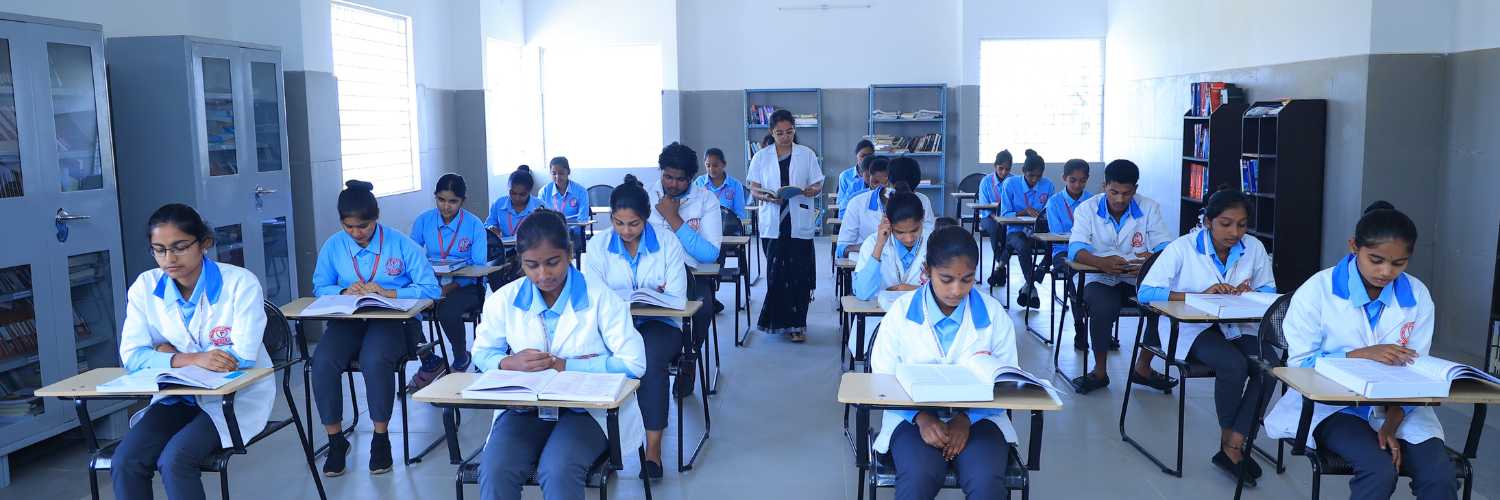
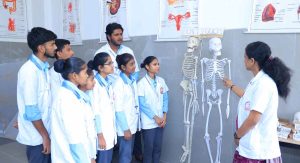
At Poornaa Pragna Institute, learning extends beyond traditional classrooms. Students spend significant time in well-equipped laboratories and clinical settings. For instance, third-year B.Sc. Nursing students actively train in maternal and child health units and participate in community visits.
Faculty members demonstrate procedures, after which students practice under supervision, ensuring skill mastery. Classroom sessions are complemented by practical exposure, while the campus provides ample facilities, including libraries, skill labs, and recreational spaces, to support overall development.
Connected & Student-First
The institute sits in Kanchamaranahalli, Hassan, Karnataka, close to MCF. The campus is easily accessible , thanks to frequent public transport options, including KSRTC buses that run every 10 minutes or so, with a stop directly in front of the campus (under KSRTC permissions). This makes daily commutes simple without much hassle.
On top of that, the college runs its own transport system with a fleet of 9 buses. These handle drops and pickups for classes, especially to clinical postings and hospital sites. The same buses support their linked PU schools, doubling up efficiently for college needs too. Overall, the setup keeps travel reliable and student-friendly, whether relying on local routes or the institute’s dedicated rides.
Building Bridges
Poornaa Pragna Institute of Nursing and Paramedical Science builds strong ties with healthcare providers to give students solid real-world exposure beyond its own 100-bed Mani Super Speciality Hospital.
The institute holds affiliations with Manjunatha Hospital in Hassan for specialized neuro and ortho training. It also has affiliations with Hassan Institute of Medical Sciences, a major 1500-bed government facility, for access to gastro and ICU setups, with an annual fee of ₹10,065 per student to support these arrangements.
In addition, students are posted to the National Institute of Mental and Neurosciences (NIMHANS) for advanced mental health experiences, while community postings round out their fieldwork. All affiliations remain active and aligned with Indian Nursing Council (INC) guidelines, ensuring hands-on practice meets top standards and prepares graduates well for professional demands.
No One Left Behind
 At Poornaa Pragna Institute of Nursing and Paramedical Science, the fee structure stands out as highly affordable when compared to other colleges in the Hassan region. The leadership places greater emphasis on supporting students’ ability to afford their education rather than on maximizing charges. For standout performers facing financial hurdles, the institute steps in directly, for instance, currently the institute is fully sponsoring a talented third-year B.Sc. Nursing student ensuring she can complete her studies without interruption due to economic constraints. Similar support exists for other deserving pupils, so no one feels burdened by excessive costs.
Roughly half the students in B.Sc. Nursing, GNM, and paramedical programs qualify as government quota seats, where fees are kept very low, often in the range of ₹15,000 to ₹5,000 annually, as set by government norms for these categories. Private or management quota options remain manageable too, with the assurance that the value received far exceeds what families invest.
Scholarships play a big role in easing the load. Many learners hail from Karnataka’s economically weaker sections or rural backgrounds, often accessing government hostels and related aid. The institute facilitates several schemes, including merit-based options like NSP (National Scholarship Portal) and SSP (State Scholarship Portal). Beyond these, private and community-based scholarships and schemes are common, such as those from Dharmastala, Sahakari Sanga, labour department programs, Coffee Board, and similar bodies.
From Dream to Reality
To wrap up the conversation, we posed a forward-looking question to Secretary and Principal Prof. Dharani Kumari – What short-term or long-term plans does the institute have, beyond the already-mentioned physiotherapy program?
Prof. Dharani Kumari responded with clear enthusiasm and vision. “I am deeply interested in introducing many more courses closely tied to our profession,” she shared. Drawing from her own background as a professional nurse, post-graduate in nursing, and experienced critical care (ICU) specialist, she explained that the institute is actively planning to expand into allied health sciences. “That’s the reason we invested 20 crores in the building alone and maintain a 60,000 square foot college campus,” she added. “We started with a vision, and that vision continues to drive our growth. I have been involved in building this institution from the ground up,” she added.”