
Lokmanya Bal Gangadhar Tilak viewed education as more than knowledge transmission, it was a transformative force rooted in intellectual rigor, cultural heritage, and social responsibility. In his philosophy, learning intertwined with ethical grounding and civic duty, extending academic excellence beyond disciplinary mastery to foster independent thought, critical inquiry, and societal service.
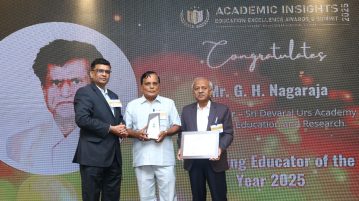
Institutions embodying Tilak’s vision bear a dual mandate, one of safeguarding the intellectual heritage that shapes national identity, while also adapting to contemporary demands. Tilak Maharashtra Vidyapeeth (TMV) exemplifies this as a multidisciplinary deemed university, blending national priorities with global standards. At Academic Insights, we proudly recognize TMV’s sustained efforts with the “Distinguished University of the Year 2025 – Excellence in Digital Campus Infrastructure” award.
A Century of Legacy and Institutional Evolution
Celebrating its 100 years of legacy in 2021, TMV is envisioned as an institution that would nurture character, self-reliance, cultural integrity, and social responsibility. Over the past decade, the Vidyapeeth has undertaken significant academic and structural reforms, aligning its curricula with the National Education Policy (NEP) 2020 and adopting multidisciplinary, outcome-based learning pathways. Alongside curricular renewal, TMV has digitised its academic and administrative systems, enhanced research output, and expanded inter-university collaborations within India and abroad.
Tilak Maharashtra Vidyapeeth has also made significant strides in research and innovation, securing patents and setting world records, while proudly upholding the rich legacy and cultural values on which it was founded.
An Interdisciplinary Core
The Vidyapeeth offers programmes across a wide spectrum of disciplines, including Ayurveda, Sanskrit and Indology, Japanese Studies, Law, Physiotherapy, Hotel Management, Computer Science, Mass Communication, and Digital Arts. Apart from subjects taught individually, The hallmark of TMV is their multi-faculty ecosystem which creates structural opportunities for collaboration across disciplines.
Long before regional language instruction gained national policy emphasis, TMV had institutionalised education in vernacular languages, reinforcing accessibility and inclusivity.
Contemporary academic offerings extend into emerging and industry-relevant domains such as Artificial Intelligence, Data Science, Machine Learning, Digital Media, and Music and Audio Production.
Innovation Infrastructure
The Vidyapeeth has established advanced facilities, including AI/ML laboratories, a Game Lab, and a Sound Studio with a preview theatre, to support experiential and technology-driven learning. Interdisciplinary research clusters bring together expertise from health sciences, social sciences, language studies, and technology. In addition, the Vidyapeeth regularly organizes national and international conferences, seminars, and workshops, and supports strong academic output through publications and research forums.
A distinctive feature of TMV’s employability framework is the Apprenticeship Embedded Degree Programme (AEDP), which integrates formal education with sustained industry experience. Notably, TMV has emerged as a national leader in Japanese Studies, with nearly 70 percent of India’s recipients of the prestigious Mombusho (MEXT) scholarship being TMV students.
From Research to Real-World Impact
TMV’s innovation ecosystem is anchored by the Centre for Innovation and Entrepreneurship Development (CIED) and its Section 8 company – TMV FIED (Foundation for Innovation & Entrepreneurship Development).
Holistic student development at Tilak Maharashtra Vidyapeeth extends well beyond the classroom. The Placement Cell, in collaboration with CIED, facilitates internships, industry interactions, and structured skill-development programmes. To strengthen academic rigour and research culture, TMV provides seed money, consultancy opportunities, and robust support for research fellows, including JRF/SRF scholars. The faculties actively contribute to publications, patents, and collaborative research with national and international partners
TMV’s contribution to India’s cultural and intellectual heritage is most visibly reflected through the Shri Balmukund Lohia Centre of Sanskrit and Indological Studies, along with its faculties of Sanskrit, Indology, and Ayurveda. These departments play a vital role in preserving, digitising, and reinterpreting classical texts and rare manuscripts. Among their most significant scholarly contributions is the Ayurvediya Triskandha Kosha, a comprehensive research project spanning over 13,000 pages and representing more than three decades of dedicated academic effort.
Looking Ahead
As TMV charts its path for the next five years, its strategic priorities include expanding international collaborations, strengthening research excellence, modernising infrastructure, and introducing future-ready, skill-based programmes. Plans to scale online education, deepen apprenticeship-based learning, and establish specialised research centres in areas such as Sanskrit, Digital Humanities, and Indigenous Studies promoting Indian tradition to go far beyond boundaries.