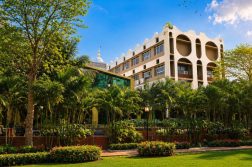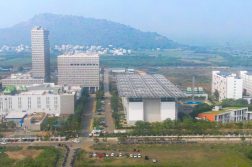
As modern urban landscapes undergo unprecedented transformation, architecture can no longer be viewed simply as the act of erecting physical structures. It has evolved into a vital form of environmental intervention, an aesthetic, socio-economic, and deeply human practice that directly shapes the fabric of everyday life. Yet, while legacy institutions frequently rely on century-old routines, Mumbai’s Thakur School of Architecture & Planning (TSAP) has spent its formative years establishing a radically responsive blueprint for the contemporary designer.
Founded on the conviction that ‘true architecture thrives at the intersection of scientific invention and artistic innovation’, TSAP balances a deep reverence for classical Indian and global architecture with an agile vision to challenge the status quo. What truly elevates the institute into the elite tier of India’s design education is this holistic, multi-disciplinary approach. By integrating socio-economic planning, the humanities, cutting-edge technology, and intellectual property ethics into its core fabric, TSAP ensures its students never design in isolation. They emerge not just as technical draftsmen, but as empathetic urban catalysts.
Breaking Boundaries
Established in 2014, under the prestigious aegis of Zagdu Singh Charitable Trust (ZCT), TSAP was born out of a visionary commitment to the advancement of learning. Under the leadership of Chairman V. K. Singhji, the trust operates on the foundational belief that education must continuously evolve alongside the shifting aspirations of society, industry, and the global community. Fully approved by the Council of Architecture (COA), the Directorate of Technical Education (DTE), and the Government of Maharashtra, this Unaided, Hindi linguistic minority institution is officially affiliated with the University of Mumbai.
In the landscape of modern education, turning an institution into a powerhouse of innovation requires more than administrative governance—it demands a visionary who can bridge the gap between academia and the rapidly evolving global market. As the Chief Executive Officer guiding the Thakur School of Architecture and Planning (TSAP), Karan Singhji embodies this transformative leadership.
Steering an entire institution toward a high level of consistent national excellence, however, requires moving far beyond traditional academic metrics. According to the CEO Karan Singhji, the secret sauce to driving this disruption isn’t a single policy or a modern software suite. Instead, it is a relentless adherence to a leadership philosophy, which includes – The Pedagogy of Process, intentional Industry-Academia Convergence, and a continuous PDCA (Plan-Do-Check-Act) Cycle.
Karan Singhji’s leadership is distinctively informed by the vast ecosystem of the Thakur Group. With a robust footprint spanning critical sectors like Finance, Construction, Consultancy, and Real Estate Development, he does not view architecture through a singular, isolated lens. Instead, he understands it as a vital cog in a massive economic and structural machine.
Under his guidance, TSAP students aren’t just taught to design buildings; they are trained to understand:
- The financial viability of projects.
- The practical constraints and breakthroughs of modern construction.
- The strategic insights of top-tier consultancy.
- The forward-thinking vision required of premium developers.
By infusing these diverse industry insights into the academic framework, Singhji has transformed TSAP from a traditional design school into a holistic incubator for future built-environment leaders.
Recently, TSAP marked a definitive turning point by transitioning to autonomous status. Over the past two academic years, this structural freedom has empowered the institute to break free from rigid, hyper-regulated academic boundaries and thoroughly overhaul its curriculum. This newly minted institutional agility has digitally transformed all its core verticals – the flagship five-year full-time Bachelor of Architecture, the B.Voc in Interior Design, and a pioneering, industry-ready M.Arch in Real Estate Development.
Crucially, this autonomous curriculum has completely reversed traditional teaching, by prioritizing the deep rationale behind a design rather than just the final product.
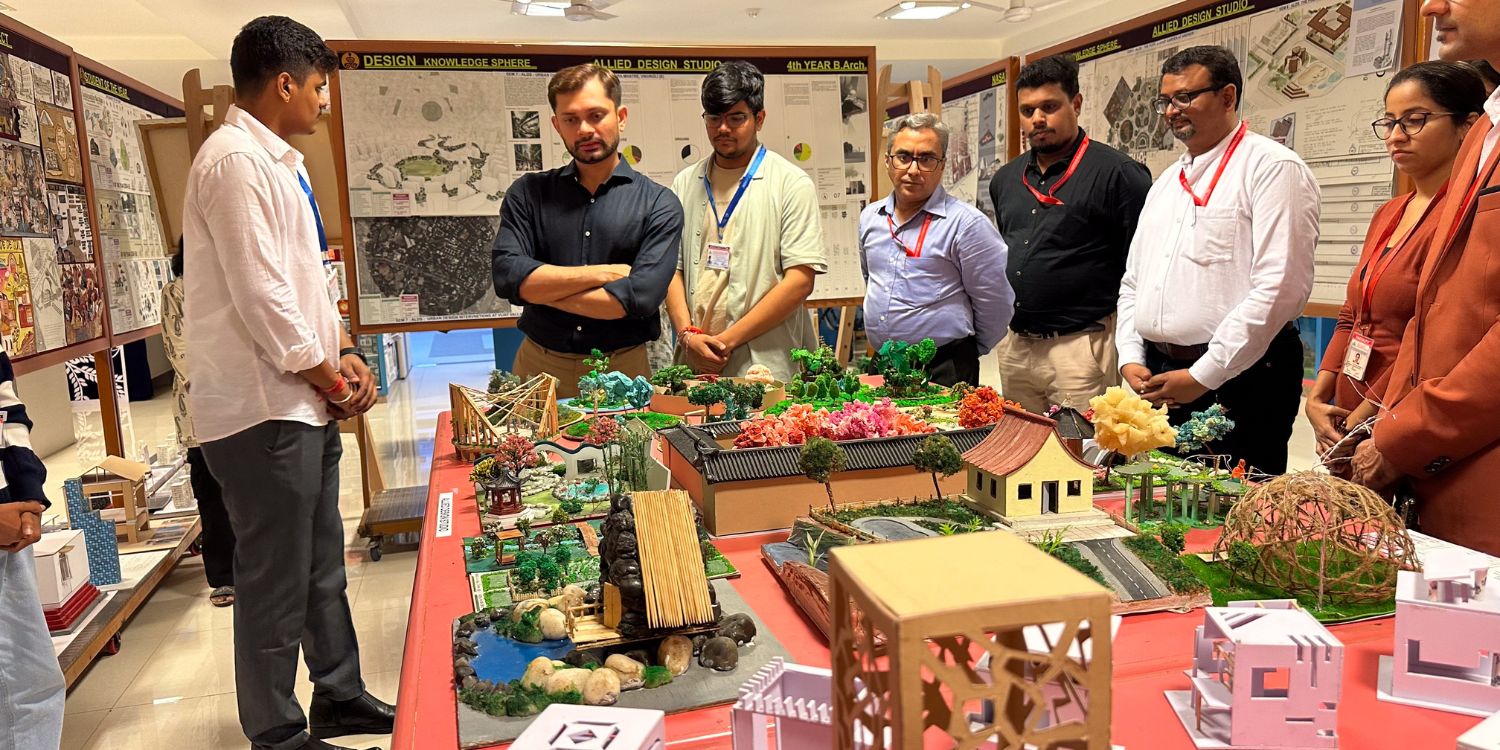
TSAP has successfully restructured its conventional design studios into research-oriented laboratories where students are assessed on critical inquiry, spatial iterations, and the rigorous evolution of their concepts. By embedding the ISO 21001:2018 Certified practices into both the student design studios and the faculty development frameworks, continuous improvement becomes a standard reflex rather than an occasional goal. Further, to future-proof its graduates, the institute has also introduced targeted, outcome-based modules and time-bound design challenges, specifically engineered to cultivate human ingenuity and counter the rise of AI and automated drafting.
Importantly, across every lesson taught at TSAP, students are made to realise a sobering reality that every single line drawn on a blueprint carries a financial cost and a legal consequence. By training designers to consciously navigate and master these regulatory and economic forces, the institute ensures its graduates do not leave its gates just looking for employment, instead, they exit as entrepreneurs and strategists.
Global Exposure and Global Perspectives
A defining trait of Singhji’s leadership is his extensive international exposure. In an era where urbanization, climate change, and smart cities demand global solutions, he has ensured that TSAP operates on a world-class wavelength. By observing and integrating international best practices, he has pushed the institute to adopt cutting-edge pedagogical tools, global design standards, and collaborative research initiatives. This global outlook ensures that TSAP graduates are equally equipped to design a sustainable community center locally or spearhead a high-tech skyscraper abroad.
Re-envisioning Mumbai
Reflecting on the evolution of the institute over the years, the CEO Karan Singhji states “TSAP produces Empathetic Urban Catalysts practicing a Pedagogy of Process”. This unique professional identity is a direct result of the institutional freedom through autonomous status, catalyzed by the formal launch of flagship umbrella framework, the TSAP-ALIVE (Autonomy Led Innovative Value-added Education) empowered by management support.
Over the last two academic years, this hands-on philosophy found its definitive expression under the institutional theme, “Re-envisioning Mumbai.” Departing completely from the academic tradition of assigning hypothetical sites, the design studios adopted actual, high-friction urban zones across the Mumbai Metropolitan Region (MMR). A primary success story emerged from extensive studio work centered on the urban transformation of Mumbai’s overlooked transit sub-centers and historical urban villages, known locally as Koliwadas.
Driven by the dynamic mechanics of the TSAP-ALIVE framework, teams of final-year and postgraduate students spent months conducting ground-level participatory mapping, demographic surveying, and sophisticated spatial analytics. The researchers collaborated directly with local resident communities, municipal ward officials, and urban stakeholders to co-create sustainable tactical interventions. This included decentralized infrastructure consisting of waste management and greywater filtration nodes integrated directly into the narrow lanes of the urban villages, alongside climate-resilient spaces equipped with much-needed flood mitigation catchments.
Lastly, they designed adaptive transit layouts to ease hazardous pedestrian-vehicular conflicts around critical local railway stations. The compiled data, meticulous architectural drawings, and physical models generated under this theme are ultimately presented to municipal authorities and local civic bodies. Impressed by the technical brilliance displayed, alongside the financial feasibility and sharp social responsiveness of the proposals, city planners explicitly have referenced the student-generated public space mapping to guide local municipal ward interventions.
The Power of Synergy
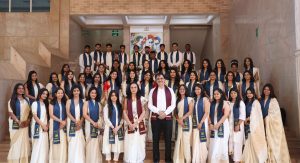 Operating as a flagship institute under the renowned Zagdu Singh Charitable Trust (ZCT) has enabled the institution to systematically extend its classroom boundaries through an expansive network of international memberships and global collaborations. TSAP’s commitment to broad-based industry readiness is anchored by elite national and global associations, such as its United Nations Academic Impact (UNAI) membership, which engages the academic community in global goals like sustainability and conflict resolution. Similarly, through memberships with the Council of Tall Buildings and Urban Habitat (CTBUH), students gain direct access to the latest research in contemporary urban development alongside global thought leaders. The institute also builds crucial pathways with professional bodies like the Charles Correa Foundation, the Indian Green Building Council (IGBC), and the Fire Security Association of India (FSAI).
Further enriching this ecosystem are deeply rooted institutional collaborations which feature partnerships with pioneering groups like the Hunnarshala Foundation and ETHOS Arcause. This stellar industry-academia bond is complemented by an incredibly active global footprint, where students have traveled to over five international destinations, including the UAE, Italy, France, the Netherlands, Spain, and Singapore, while more than nine international universities have visited the Mumbai campus for academic exchange and collaboration. Domestically, the institute has completed over thirty certified programs in collaboration with top-tier national institutions and industry bodies, including IIT Kharagpur, COEP, and CREDAI-MCHI.
Ultimately, these robust corporate and institutional relationships naturally translate into phenomenal career trajectories for its graduates. Leveraging this impressive network, TSAP has established an intensive, highly focused placement training ecosystem designed to bridge any remaining gaps between academia and corporate expectations.
A Dynamic Voice in the Industry
As a young, dynamic leader, Singhji is a highly sought-after voice on various prestigious industry and academic panels. His contributions to these forums go far beyond standard representation; he acts as a crucial conduit between the corporate world and the classroom.
On these panels, he consistently champions:
The Culture of Innovation: Pushing for curriculums that embrace disruption rather than resisting it. Technological Integration: Introducing advanced tech like Building Information Modeling (BIM), AI in design, and sustainable green technologies directly into the student experience. Deep Industry Connections: Forging powerful alliances with leading developers, tech firms, and architectural practices to guarantee that TSAP students have unparalleled access to internships, mentorships, and real-world case studies.
The Visionary Legacy
Ultimately, Karan Singhji’s role at the Thakur School of Architecture and Planning is defined by a relentless pursuit of the future. He has redefined the role of a modern educational leader—proving that when you combine the agility of a developer, the precision of a financier, the foresight of a consultant, and the energy of a global innovator, you create an environment where students don’t just learn about the future; they actively design it.
The Blueprint for Tomorrow

When asked about the future of Thakur School of Architecture and Planning of the institute, CEO Singhji outlined a roadmap divided into highly focused, immediate goals and visionary long-term milestones. “TSAP’s roadmap is explicitly clear,” he shared. “We are refining our autonomous academic framework to ensure our students remain highly agile and at the forefront with disruptive technologies as well as practices. In the long term, we are scaling this ecosystem to transform TSAP into a world-class center of design thinking”.
Over the next one to three years, the institute intends to maximize its TSAP-ALIVE framework by establishing a dedicated Urban Cell to package student-led design research into formal advisory proposals. TSAP is also looking forward to leveraging its flexible credit system to introduce short-term, skill-specific certificate courses covering ESG compliance and advanced building simulations, while expanding its AI-resilient pedagogical evaluations.
Looking further ahead, CEO Karan Singhji envisions transitioning TSAP from a regional leader into a global powerhouse. This long-term blueprint includes forging international dual-degree programs and global research setups, expanding the institutional footprint into a comprehensive “School of Design”, with a well-funded Design Venture Incubator to empower students and faculty to patent innovative materials and launch independent design startups.