
Global Education Icons 2026
India's 20 Most Inspiring Education Leaders 2026
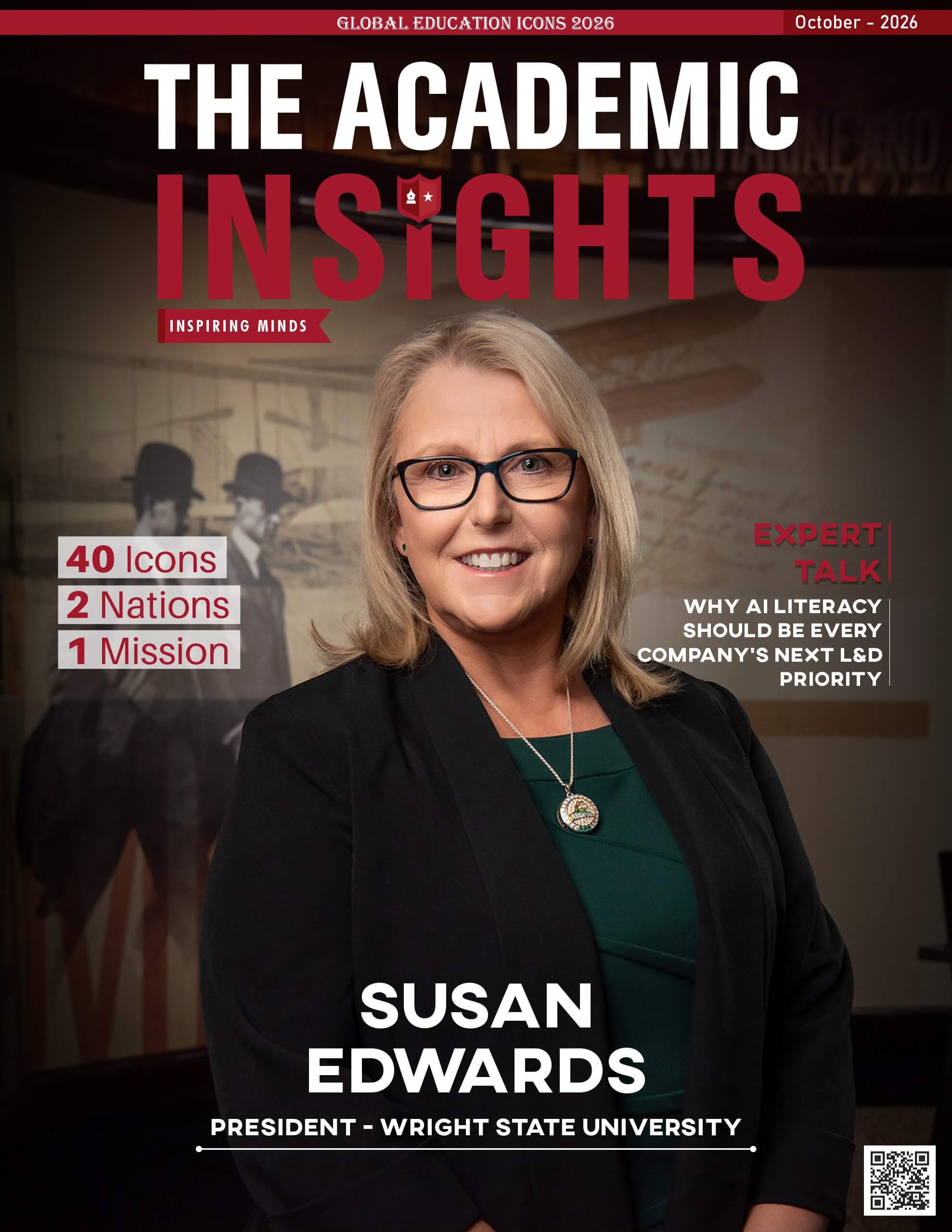
India is home to one of the largest education systems in the world, and one of the fastest changing. In the years since the National Education Policy 2020, institutions across the country have been asked to do several things at once: widen access, raise quality, make learning more flexible, build research capacity and prepare students for jobs that did not exist a decade ago. How well an institution meets that challenge depends, to a large degree, on the people who lead it.
India’s 20 Most Inspiring Education Leaders 2026 recognises twenty of those people. They come from very different corners of Indian education: founders who built universities from a single college, vice-chancellors steering public institutions of national importance, and leaders shaping specialised fields such as film, sport, health sciences and school education. What they share is a record of turning a clear vision into lasting results for students.
How we shortlisted
The list was built in three stages. First, our editorial team drew up a long list from nominations, our ongoing coverage of institutions, published rankings and accreditations, and recommendations from academics and industry voices we work with. Second, we researched each name using public sources such as institutional reports, accreditation outcomes, rankings and news coverage, and confirmed current roles. Third, the editorial panel reviewed every profile against a common set of parameters before agreeing on the final twenty.
We assessed each leader on the following parameters:
- Vision and institution-building: the ability to set a clear direction and build or transform an institution over time.
- Academic quality and outcomes: accreditation, recognised rankings, graduate outcomes and placements.
- Innovation in teaching and learning: new programmes, use of technology, industry-linked curricula and alignment with NEP 2020.
- Research and industry engagement: research culture, incubation, startups and partnerships with industry.
- Access and inclusion: scholarships, outreach to rural and first-generation learners, and affordability.
- Global engagement: international collaborations, student and faculty exchange, and global recognition.
- Social impact and integrity: contribution beyond the campus, and a reputation for ethical, transparent governance.
- Sustained influence: a consistent record over years, not a single achievement.
No single parameter decided a place on the list, and the order is alphabetical by first name, not a ranking. Some leaders stand out for scale, others for depth in a specialised field, and others for what they have built with limited resources.
We recognise that any list of twenty leaves out many deserving people. India has thousands of committed educators whose work rarely makes headlines. This edition is not a final word on who matters most, but an invitation to look closely at what good leadership in education looks like today, and what it might take to build on it.
| Inspiring Education Leader | Institute / Location |
|---|---|
| Dr. Anirudh Gupta, CEO | DCM Group of Schools |
| Dr. Ashok K. Chauhan, Founder President | Amity Education Group (Ritnand Balved Education Foundation), Noida |
| Prof. (Dr.) C. Raj Kumar, Founding Vice-Chancellor | O.P. Jindal Global University, Sonipat |
| Dr. Devesh Kumar Singh, Chairman | Noida International University, Greater Noida |
| Mr. Dhermesh Manghnani, President | New Horizon College of Engineering, Bengaluru |
| Dr. G. Parameshwara, Chancellor | Sri Siddhartha Academy of Higher Education, Tumakuru |
| Dr. Kishore Gopinathan, Vice-Chancellor | Young India Physical Education and Sports University (YIPESU), Hyderabad |
| Dr. M. R. Jayaram, Chancellor & Chairman | Ramaiah University of Applied Sciences / Gokula Education Foundation, Bengaluru |
| Dr. Madhu Chitkara, Pro-Chancellor | Chitkara University, Punjab |
| Shri. Manjunath Bhandary, Chairman | Sahyadri College of Engineering & Management, Mangaluru |
| Ms. Meghna Ghai Puri, President | Whistling Woods International, Mumbai |
| Mrs. Nita M. Ambani, Founder-Chairperson | Dhirubhai Ambani International School, Mumbai |
| Dr. P. Shyama Raju, Chancellor | REVA University, Bengaluru |
| Dr. Ranjan Pai, Chairman | Manipal Education and Medical Group, Bengaluru |
| Dr. Sammita Jagdish Jadhav, Director | Symbiosis Institute of Health Sciences, Pune |
| Shri. Satnam Singh Sandhu, Founder & Chancellor | Chandigarh University, Mohali |
| Mr. Shiv Nadar, Founder & Chairman | Shiv Nadar Foundation (Shiv Nadar University), Delhi-NCR |
| Dr. T. R. Paarivendhar, Founder Chancellor | SRM Institute of Science and Technology, Chennai |
| Dr. Vijay D. Patil, Chancellor and President | D Y Patil (Deemed to be University), Navi Mumbai |
| Prof. Dr. Vishwanath D. Karad, Founder President | Dr. Vishwanath Karad MIT World Peace University, Pune |
USA's 20 Most Influential Education Leaders 2026
Few education systems shape the world as much as America’s. Its universities set global standards in research, its classrooms test new ideas in teaching, and its policy debates ripple far beyond its borders. For Indian students, families and institutions, the United States remains the most closely watched education system anywhere.
It is also a system under strain. American leaders today are navigating pressure on federal research funding, intense political scrutiny, rising questions about cost and value, debates over free expression on campus, and the arrival of AI in every classroom. Leading through this period takes more than administrative skill. It takes steadiness, clear values and the ability to bring very different communities along.
USA’s 20 Most Influential Education Leaders 2026 recognises twenty people doing that work. The list is deliberately broad. It includes presidents and chancellors of major research universities, leaders of the nation’s largest teachers’ unions, and the founders of organisations that have changed how millions learn. It also includes leaders in enrolment and international affairs, whose influence is felt in individual students’ lives every day.
Several leaders on this list were born or educated in India, a reminder of how closely the two systems are linked.
How we shortlisted
Our editorial team built a long list from nominations, our coverage of US institutions and their partnerships with India, and widely respected public sources. We then researched each name, confirmed current roles as of this edition, and reviewed every profile against the same set of parameters.
We assessed each leader on:
- Scale of influence: reach across students, faculty, institutions or national policy.
- Institutional impact: measurable progress in research, student outcomes, access or financial strength under their leadership.
- Leadership through challenge: steadiness in handling funding pressure, political scrutiny and campus tensions.
- Innovation: new models of teaching, learning or university design, including the responsible use of AI.
- Access and affordability: efforts to open education to low-income, first-generation and underserved learners.
- Global engagement: partnerships with institutions abroad, including India, and support for international students and scholars.
- Thought leadership: contribution to the national conversation on what education is for and how it should change.
- Integrity and consistency: a sustained record of principled, transparent leadership.
The list is alphabetical by first name and is not a ranking. Influence takes many forms: some leaders shape national policy, others transform a single institution, and others change one student’s path at a time.
It is not a final verdict, but a window into how these leaders are steering through a demanding moment, and what other systems, including India’s, might learn from them.
| Inspiring Education Leader | Institute / Location |
|---|---|
| Alan M. Garber, President | Harvard University, Cambridge, Massachusetts |
| Christopher L. Eisgruber, President | Princeton University, Princeton, New Jersey |
| Daniel Diermeier, Chancellor | Vanderbilt University, Nashville, Tennessee |
| Jonathan Levin, President | Stanford University, Stanford, California |
| Linda Darling-Hammond, Founding President | Learning Policy Institute, Palo Alto, California |
| Maurie D. McInnis, President | Yale University, New Haven, Connecticut |
| Michael M. Crow, President | Arizona State University, Tempe, Arizona |
| Michelle L. Reina, Assistant Vice President, International Affairs | Concordia University Wisconsin, Mequon, Wisconsin |
| Mung Chiang, President | Northwestern University, Evanston, Illinois |
| Neeli Bendapudi, President | The Pennsylvania State University, University Park, Pennsylvania |
| Pradeep K. Khosla, Chancellor | University of California San Diego, La Jolla, California |
| Princess Moss, President | National Education Association (NEA), Washington, D.C. |
| Randi Weingarten, President | American Federation of Teachers (AFT), Washington, D.C. |
| Renu Khator, Chancellor & President | University of Houston System, Houston, Texas |
| Ronald J. Daniels, President | Johns Hopkins University, Baltimore, Maryland |
| Sal Khan, Founder & CEO | Khan Academy, Mountain View, California |
| Sally Kornbluth, President | Massachusetts Institute of Technology (MIT), Cambridge, Massachusetts |
| Sian Leah Beilock, President | Dartmouth, Hanover, New Hampshire |
| Susan Edwards, President | Wright State University, Dayton, Ohio |
| Wendy Kopp, CEO & Co-Founder | Teach For All, New York, New York |
-
Editorial:
 Leaders Putting Sustainability at the Heart of Education
Explore how education leaders in India and the USA are advancing sustainability through green campuses, renewable energy, environmental education and responsible leadership......
-
In-House:
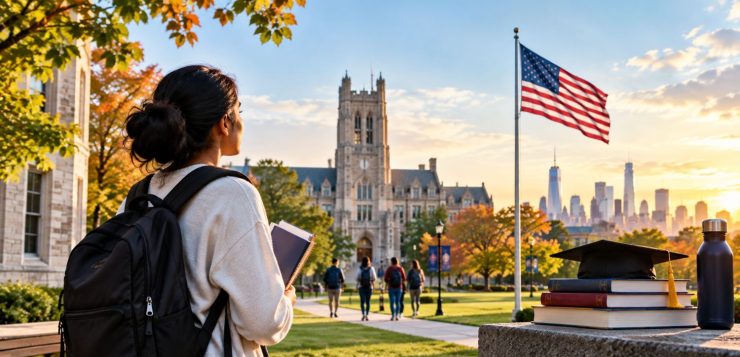 What Indian Students Should Know About US Campuses in 2026
Planning to study in the USA? Explore 2026 updates on student visas, OPT rules, H-1B changes, tuition costs and essential tips for Indian students.......
-
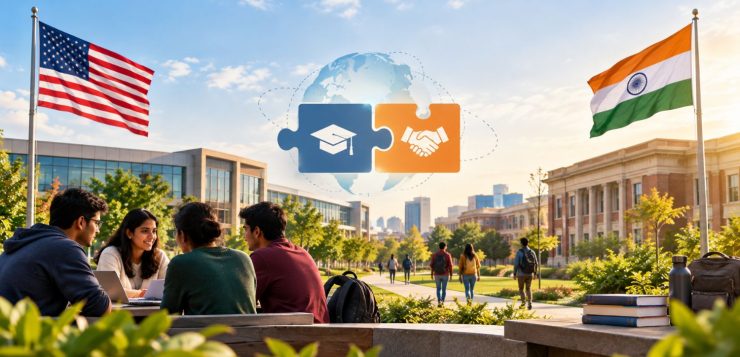 Foreign Campuses on Indian Soil – Competition or Collaboration?
Explore how foreign university campuses in India are reshaping higher education through competition, global partnerships, research collaboration
-
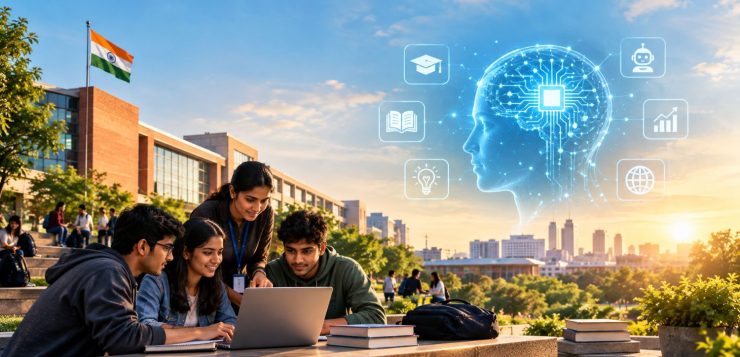 Leading Indian Education Through the Age of Intelligent Machines
Explore how education leaders in India and the USA are advancing sustainability through green campuses, renewable energy, environmental education and responsible leadership....
-
 Women at the Helm
Explore women's leadership in Indian higher education, the barriers to career advancement, faculty representation and steps to improve gender equality in academia...